
Call Center · 7 min read
Can an outsourced call team book the right service at the right location?
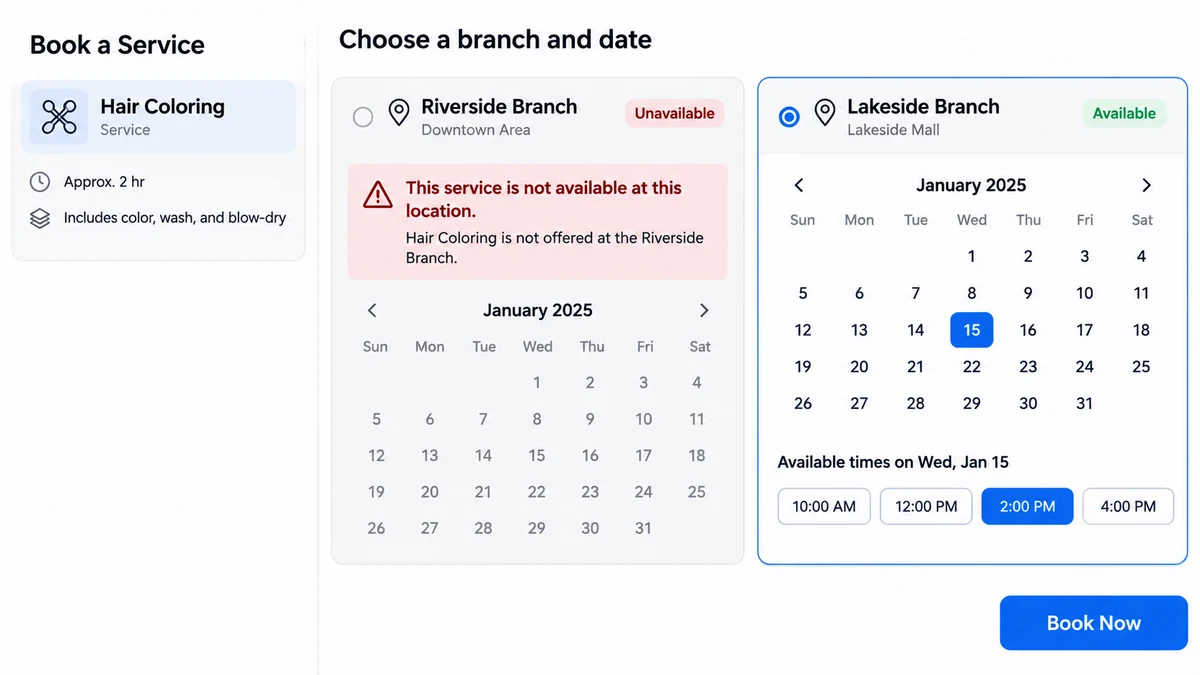
The calendar can show an open time at the wrong branch. Give callers and agents a way to check service, location, and ownership before confirming.
Give the agent permission to book the right slot
To prevent wrong-location bookings, give agents a current list of services by location, clear rules for choosing a branch, and access to a calendar that reflects those rules. Have them confirm the location, service, and time with the caller before sending a confirmation. If an exception needs approval, tell the agent who can make the decision and what to say while it is pending. I want the booking instructions to work even when the caller does not know which branch they need.
Consider a Dallas customer who asks for the first available appointment and mentions a previous visit at a different office. The first opening may be at a location that cannot provide the service the customer needs. If the agent sees only one shared calendar, it looks like a reasonable choice. That is a routing and availability problem. Training the agent to speak more confidently will leave the same bad option on the screen.
Create a service list that matches what customers ask for
Write down the words a caller uses and the name of the appointment the business offers. Describe which locations handle it, who can provide it, how long the slot is, and any time that must stay clear before or after it. Include age, equipment, or staffing restrictions only when the business has confirmed they are appropriate to use. If the agent cannot determine eligibility from an approved question, give them a person who can resolve it.
Do this with a manager from each branch. A branch manager can tell you about an appointment shown as available even though the necessary equipment or staff is unavailable. Microsoft Bookings is one example of a scheduling platform with service availability, staff availability, and buffer settings. Use the features your own system has, then test the outcome. An agent rule that says to leave time between visits has to agree with what the calendar will actually offer.
Make a short list of services that should never be confirmed on the first call. A request may need a written estimate, a supervisor, or a check on service area before the business can promise an appointment. State what the agent should record in that case and which team handles it next.
Set an order for choosing the location
Ask the caller which branch they prefer and verify that it can provide the requested service. If there is no preference, use an approved way to suggest locations, such as a city, neighborhood, or travel preference. Check which alternative branches can take the appointment before offering options. If someone already has an open request or works with a particular staff member, follow the business's instruction for continuity instead of assuming every location is interchangeable.
When you read the appointment back, say the branch name and give the full address or other verified location information the caller needs. Ask whether they recognize it as the location they intended. A street name or building nickname may be ambiguous across a metro area. In a confirmation, include the location and appointment information together. The same name should appear in the calendar, the message, and the internal handoff so staff can tell which booking the caller received.
Treat the calendar as an operating tool
Find out what the calendar tracks at each location. It may need to account for a person, a room, equipment, or more than one of them. A free hour on an employee's calendar is only useful when the other requirements are also met. Ask who blocks hours when a room is taken out of service or the branch changes its staffing. If managers make changes in a separate calendar, verify how those updates reach the one the agent uses.
Avoid leaving agents to copy appointments between tools without a clear owner. The business should know which record determines whether the slot is open and who corrects it if two people try to claim it. Ask how changes and cancellations appear in the branch calendar and who contacts the caller. A business that uses a manual handoff can still keep one authoritative appointment record if it is clear who enters it and what counts as confirmation.
Know which requests need a handoff
Some calls cannot be resolved through normal booking rules. A customer might ask for a location that does not offer the service or an appointment that needs approval. The agent should record what the customer wants, tell them the appointment status, and route the request to a named team. Give that team a due time and a fallback contact. An appointment request that needs approval should be easy to distinguish from a confirmed appointment in any message the customer receives.
When businesses in Dallas–Fort Worth ask us about outsourced appointment setting, I suggest testing that exception on the first call review. Have a branch manager listen to the words the agent uses and see where the note arrives. If it shows up in a general inbox nobody owns, change the handoff before adding volume. Our questions to ask a call center before signing can help you check which decisions the provider can own and which stay with your team.
Test the difficult calls before adding every branch
Run an ordinary appointment, a caller willing to visit another location, and a caller who asks to change a booking. Then try the cases that usually cause rework. A service can be available at one location and fully booked there. A calendar can show a slot during a temporary closure. A caller can ask for someone by name who now works at a different location. Use a safe test environment or clearly identified test entries and have each branch check what arrived.
Ask the test caller to read the confirmation message and tell you where they would go. Have a manager verify that it matches the actual booking. Check that the assigned person sees the same date and service, and that a cancellation frees the right time. Our guide to getting an outsourced call team ready covers the broader setup. Here I want the business to agree what a correct booking looks like before agents take regular calls.
Compare scope and cost by location complexity
Ask how the provider prices initial setup, later calendar changes, additional agent training, and call review. Several branches using the same services and one calendar can be easier to support than branches with different hours, rules, and tools. A setup quote should say who maintains the location list and who handles changes when an employee leaves or a service moves. If the price includes writing scripts, ask if it covers rescheduling and exceptions as well as the initial booking.
Choose a small set of review measures the branches can confirm. Count wrong-location bookings, appointments made for unavailable services, unresolved exceptions, and cancellations caused by scheduling errors. Ask for examples along with the totals. A busy branch with few reports may have a clean process or may lack a way to report problems. My guide to reviewing call-team performance explains how to use reports to find work that needs attention.
Decide who updates the rules when a branch changes
Make one person responsible for releasing changes to agents. A holiday closure, staff departure, or service relocation can reach branches at different times. Ask managers to send the effective date and say whether existing appointments need attention. Give the agent team the new instruction through the place it already consults while on a call, and remove or date the old instruction so the two do not circulate together.
If the change affects appointments already on the calendar, identify them and give someone responsibility for contacting customers. Ask what options the person can offer and where to record the result. It helps to decide in advance whether agents can move an existing booking or need branch approval. Otherwise a person may be moved on one calendar and still appear at the original branch on another.
For businesses that take calls across time zones, add the time zone to the confirmation when there is any ambiguity. Verify whether the scheduling tool shows the caller's time, the agent's time, or the branch's time. Run the same test from two locations before assuming the message is clear. The point of the check is to see what the caller actually receives and compare it with the local time on the branch calendar.
Bring an example of a booking that went wrong
If an appointment was made at the wrong branch, bring a version of the call or notes with customer information removed, the confirmation, and what the branch calendar showed. Tell us the intended service, the location you would have chosen, and why. We can review where the caller and agent lost the thread and discuss whether the issue belongs in the script, the calendar, the permissions, or the handoff. Start with the branches that use the most different booking rules.
Before hiring a provider, ask to see a short test using your own branch list. Give the agent a caller who can visit either location and another who needs a service offered only at one. Look for a clear answer in both cases. If the company will book directly into your system, find out how a manager can correct a mistake and how quickly the correction reaches the customer. That makes the selection about what happens on the call and after it.
Questions people ask me
Should each branch have a separate calendar?
That depends on how your system represents locations, staff, and other resources. Use the setup that gives agents reliable availability for the exact service and branch they are about to confirm.
Can agents move a caller to another location if one is full?
Yes, if the business authorizes it and the other location can provide the service. Ask agents to verify that the alternative works for the caller before confirming it.
What should an agent say if the branch needs to approve the appointment?
Tell the caller their request has been sent for review and explain the agreed next step. Keep the request visibly pending until the responsible person confirms it.
How should I check the provider's work after launch?
Review calls and branch calendar entries together. Track specific errors, such as wrong branch or unavailable service, and assign someone to correct the rule that caused them.
Sources
Keep reading
More from Karl
- Paying too much for phones, internet and wireless? How to audit your business telecom bills
- Do your work trucks need ELDs? How a Texas business can tell, and what to do next
- 24/7 answering, after-hours or overflow: how much phone coverage a business really needs
- Your call team is live: how to read the reports and tell whether it is working
Running a business
- Business Consultant · Armando
- Business Broker · Michael
- Franchise Consultant · Avinash
- Recruiting and Staffing Services · Chase
- Information Technology · Anthony
- Computer Software · Brandon


