
Life Coach · 7 min read
When you keep saying yes and your calendar has no room left
You have already said yes before you open the calendar. I use the moment just before that answer to work out what you are agreeing to and why.

Start with the moment before you answer
If you keep saying yes before checking your time, try delaying the answer long enough to see what the request would displace. A quick yes may feel like the easiest way to keep a conversation moving or avoid disappointing someone. That habit makes it difficult to tell which commitments you actually want. Start with a specific request, ask when an answer is needed, and look at what you have already promised before you respond.
I’m Nader Girgawy, a life and performance coach in Irving. When I work with someone on this pattern, I ask them to bring a real conversation. Maybe a colleague asked them to take one more thing on, or a friend asked for help on the same evening they had planned to rest. What the person noticed, assumed, and answered in that moment tells us where they might have a choice next time.
The goal is to make a deliberate commitment. Sometimes that means saying yes because it matters to you. Sometimes it means asking for time, agreeing to a smaller part, or declining. You learn more from examining one real decision closely than from telling yourself you should have better boundaries in general.
Reconstruct a recent yes that cost you something
Pick a request from the last few days. Write down who asked, what they said, what you heard, and what you replied. Include what you expected would happen if you paused. You may find that the other person asked for help sometime this week and you offered to finish it tonight. Separating the request from the commitment you made opens up a different conversation.
Then note what the commitment displaced. Maybe you gave up an evening you meant to spend with family, postponed a responsibility, or had to work after everyone went home. If nothing actually had to move, notice that too. Some yeses are consistent with what you value. The exercise is meant to identify where you end up choosing between two promises after you have already made both of them.
My guide to knowing what to do and still avoiding it describes how a reaction can have a purpose in the moment even when you dislike the result later. Here, a quick yes might preserve your reputation for being dependable. The cost appears after the conversation, when you see that you offered something you did not have room to do.
Give yourself a sentence that buys enough time
Choose one line you can use without a speech. You might say, “I need to check what I’ve already committed to. When do you need an answer?” Say it to a person you trust first if that helps. The point is to hear what the other person actually needs before volunteering more than they asked for.
If someone needs an answer immediately, check the smallest commitment you could make honestly. You might have time to review an outline and be unavailable to own the whole project. You might already know you cannot make the deadline. A narrower answer lets the other person decide whether it is useful, and it leaves you with something you can deliver.
Write down when you agreed to respond. A pause works better when the person knows you will return with an answer. Otherwise, you may spend the rest of the day avoiding the conversation and end up saying yes under more pressure than you felt the first time.
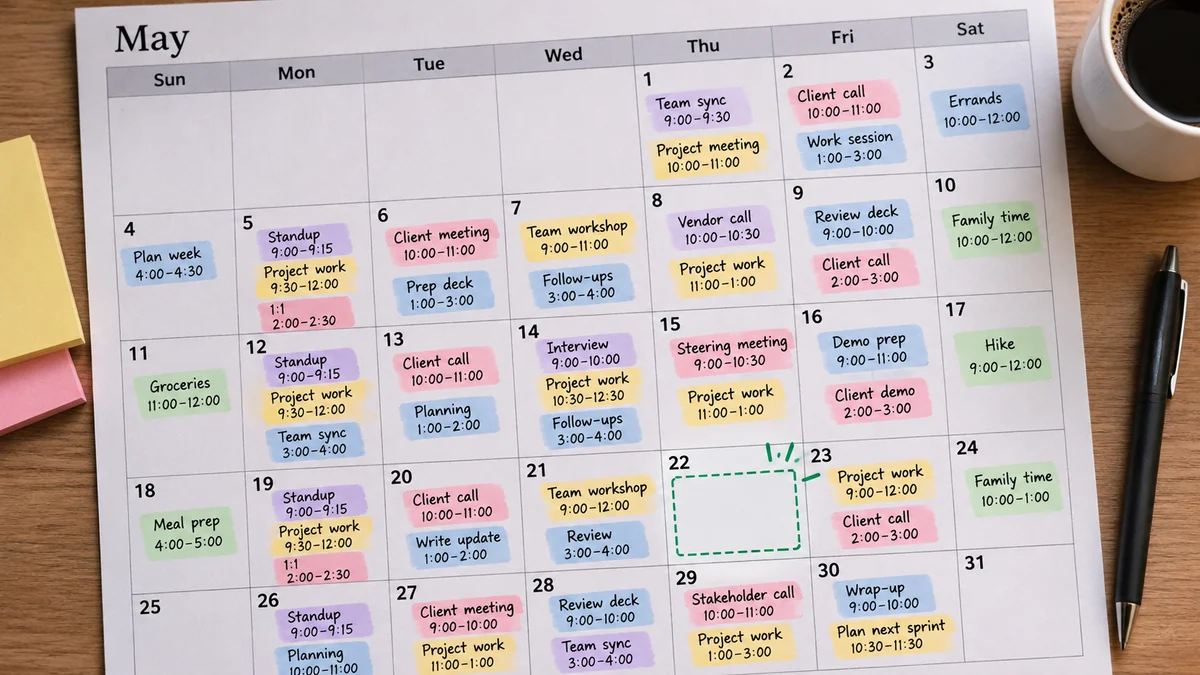
Look beyond the empty block on the calendar
Count the work around the request as well as the time it appears to take. If you agree to an evening meeting, you may also need travel, preparation, or a conversation afterward. If someone asks you to manage a project, find out whether it includes follow-up or future meetings. Ask them to describe what finished looks like before you decide if the time works.
Use the same test for your own commitments. Think about the time you set aside for home responsibilities, sleep, a personal project, or doing nothing for an hour. Ask whether you would move that block if the request came from someone else. A clear calendar can still hold commitments you do not put in an invitation.
If two responsibilities both matter, write them in front of you and decide what changes. A response at work might be, “I can take this on if we move the client draft to Thursday. Which would you like me to prioritize?” This gives a manager an opportunity to choose instead of assuming your other assignment will still happen as planned.
Find out what you are protecting with the quick yes
If you often agree to things with one person or in one setting, look for the assumption you make there. You might believe you must always be available to earn trust or that a reasonable request is automatically your responsibility. Ask yourself where you learned that rule and whether you apply it to the people you respect. My guide to ontological coaching explains the kind of inquiry I use around assumptions and identity.
Bring one example if you want to explore it with me. In a conversation with someone in Dallas–Fort Worth, I would ask what they saw as the choices at the time and what they think a different answer would have meant. We can practice saying a clearer response and see what feels difficult about it. The aim is to give you an experiment you can actually try in the next conversation.
If the request involves a power difference or you depend on the other person, take that into account. The best first step might be asking which existing responsibility should move, rather than declining outright. I would want to understand your context before suggesting a practice.
Make the answer short enough to remember
When you know the answer, say it before explaining it. Try, “I can review the draft Friday morning, but I cannot take on the rewrite.” If you are declining, you can say, “I’m unavailable for that this week.” A brief reason can be helpful when someone has to plan around you. You do not have to account for every other obligation on your calendar.
Watch for a second quick yes during the follow-up. If the person asks for a new deadline or a different task, listen to that as a new request. Compare it with what you can do before you agree. This is where rehearsing one line can help. You have a way to respond while you decide, rather than improvising through the whole discussion.
If you decide to offer a smaller part, define the edge of it. Reviewing a draft might mean sending comments by a certain time. It might also become an expectation that you attend follow-up meetings unless you clarify. Say what help you can offer and ask whether that is enough for the other person to make a decision.
Learn from what actually happens after you respond
After the conversation, write down what you predicted and what the person actually said. You may find they accepted the smaller offer or asked someone else. You may find the request mattered more than you understood. Both reactions give you better information than the story you anticipated before you answered. If it did create a problem, look at whether you can change the way you asked or the commitment you offered.
Review one example a week for a short period. Look for the request where you made a choice you could keep. If you agreed to more than you meant to, practice a correction early. You can say you have checked your availability and explain what you can still do. Correcting a commitment gives the other person more time to make a plan than waiting until you miss it.
My guide to what happens in a coaching session explains how we can take a situation from everyday life and work through the moment a choice appears. Bring both the attempts that went well and the ones you would answer differently now.
If you receive a response you did not expect, check what part of the conversation led to it. The other person may have heard your offer as tentative or assumed you were taking on more work. Ask them what they understood. That gives both of you a chance to correct the misunderstanding before it becomes another commitment you did not intend to make.
What to bring to a first coaching conversation
If you are in Dallas–Fort Worth or want to work with me online, bring a recent commitment you wish you had handled differently. Say what you wanted to do, what you were afraid might happen if you asked for time, and what response would fit your circumstances now. We can discuss whether the work you want is a fit for coaching and which situation would make a useful place to start.
Ask a coach how sessions work, how confidentiality is handled, and how you will know if the work is helping. The International Coaching Federation’s ethics code describes the importance of a clear agreement about the roles and terms of coaching. My guide to choosing a life coach gives you more questions to ask during an introductory call.
Choose a result you can recognize. It could be waiting until you check the calendar, making one smaller offer, or having a conversation about priorities before committing. Let that decision tell you what to work on next, even if saying yes still feels like the easy answer at first.
Questions people ask me
What can I say if I feel pressured to answer right away?
Ask when they need an answer and say you want to check your other commitments. If the timing is genuinely immediate, say what you can realistically offer.
Should I explain every reason I cannot help?
Give the information the other person needs to plan. A brief answer with your availability or an alternative is often enough to start.
What if I already agreed to do something I cannot finish?
Review what you can still deliver and contact the person early. Let them know what changed and discuss the next workable option.
Can I work on this pattern with a life coach?
A coach can help you look at a specific situation, practice what you want to say, and review what happened afterward. Ask how the coach works and what you can expect from the relationship.
Sources
Keep reading
More from Nader
- Life coach, career coach or executive coach: which kind of coach fits your situation
- Getting the most from life coaching, and keeping the change after the last session
- The conversation you keep putting off: how to start it and stay honest once it begins
- You know what to do and still do not do it: the pattern under the procrastination
Health and wellbeing
- Chiropractor · Rachel
- Physical Therapy · Brent
- Non-Profit (Mental Health) · Chris
- Non-Profit (Children) · Kylie


