
Fine Jewelry · 7 min read
Will a straight wedding band sit flush against your engagement ring?
The engagement ring’s side profile tells you more than a top-down photo. Compare both rings on the finger before ordering a band.

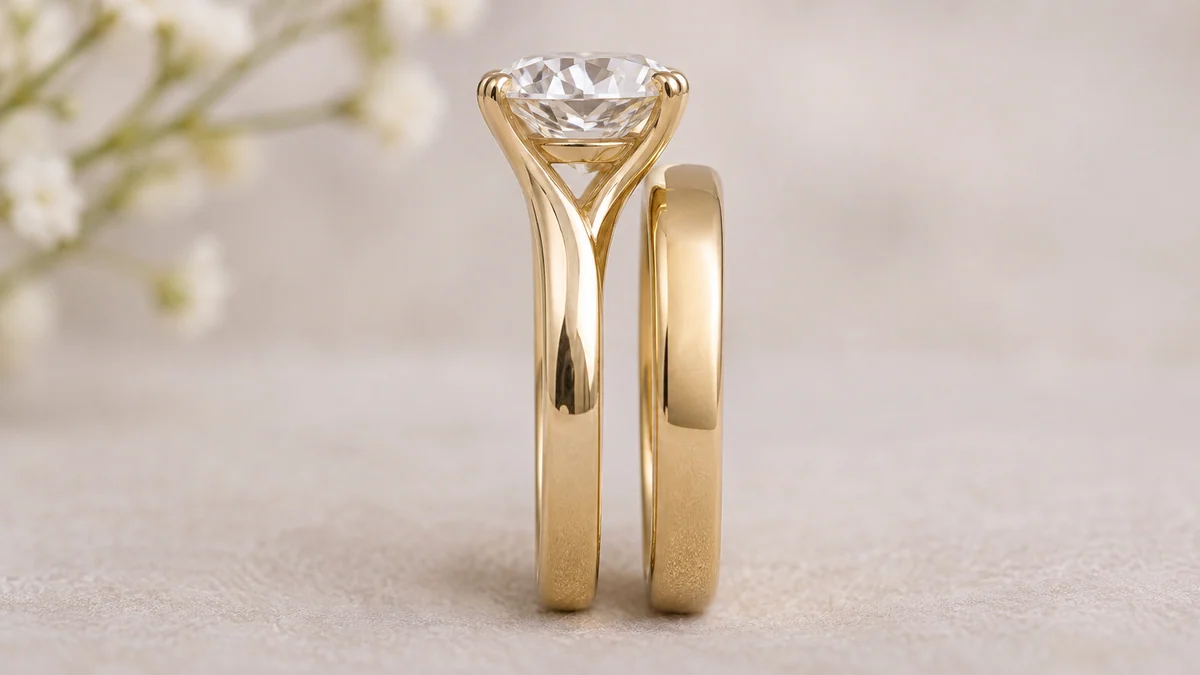
Look under the center setting
A straight band can sit flush when it has enough room beside or underneath the engagement ring’s setting. A low basket, prong support or halo can take up that space, even when a photo from above makes the ring look narrow. Take the engagement ring with you when you shop and try the band on the same finger.
At Bitton Diamonds in Dallas, I help customers choose jewelry around the way they want to wear it. Start by deciding whether you want the rings to touch, leave a deliberate space or work as separate pieces. A gap you like is a perfectly reasonable outcome. A pair that touches in one spot and pushes the engagement ring sideways is a fit question worth addressing before the band is made.
Turn the ring on its side
The band of an engagement ring, sometimes called the shank, circles your finger. The part that holds the center stone rises from it. Viewed from the side, the head of the ring may leave open space on either side, or its metal may extend right down to the shank. The widest point of the center stone may be above the band, while the metal holding it sits lower and closer to where another ring would go.
When you bring a photograph, take one directly from the side and another at an angle that shows the underside. Show the full ring so I can see whether the shank changes width or rises toward the center. A close picture of the diamond alone can hide the connection between the setting and the band.
If the ring is still being designed, bring examples of wedding bands you like. An engagement ring may have enough clearance for a thin plain band but less room for a wider one with raised diamonds. The more specific you can be about the second ring, the easier it is to evaluate the design together.
Try the straight band in the width you would buy
A plain fitting ring can be a useful first check. After that, ask to try a band with the width, thickness and decoration you are considering. Two bands of the same width may still make contact in different places. A flat outside edge and a rounded edge can meet the same engagement ring differently, and a row of accent stones adds other points to check.
Look down at the rings with your hand relaxed. Then look at them from the side and turn your palm up. The rings can look even while you hold them still and move when you make a fist or take your hand out of a pocket. Ask the jeweler to point out any part of the wedding band that contacts a prong or exposed stone. Our questions to ask a jeweler before buying can help you organize the rest of the appointment.
Choose what you want the pair to do
Try the combination with the wedding ring closer to your palm, and try the opposite order if you think you might wear it that way. The Gemological Institute of America shows different ways to wear bridal rings together, including stacking and wearing rings on different fingers. If you plan to take the engagement ring off for certain activities, pay attention to how the wedding band feels and looks when it is by itself.
A straight band that leaves space can look balanced when the gap is centered. A curved band can follow a round or oval shape. A contoured band can be designed around an engagement ring that has an unusual profile. I would put those options on the hand before asking you to choose. If you are comparing bands in Dallas, bring your engagement ring and photos of the styles you would be happy wearing on their own.
Check contact in the places that matter
Some contact between metal surfaces is expected when rings are worn together. The contact point I want to see is where an exposed edge or an accent setting meets the other ring. As a buyer, you can ask the jeweler to show you the likely wear points, how they plan to give the stones clearance, and whether the band can rotate into a position you would dislike.
A tall side stone can overhang the top of a wedding band, which means the pair may look aligned at the finger while the settings interfere higher up. Try holding the rings together off your hand and then on it. You can see where the edges line up in both positions. If a stone is already loose or a prong looks worn, have the engagement ring inspected before using it to fit a second ring. For care after purchase, see cleaning a ring at home or at a jeweler.
Consider how the stack changes the fit
The GIA’s guidance on sizing explains that bridal rings worn together may require special consideration because the combined width changes how they fit. Check the pair at the base of your finger and when you slide it over the knuckle. Let the jeweler know if one ring will often be worn separately. A size that feels secure in a stack may feel different when the band sits alone.
If you have a sample with the right outside shape but an inside profile different from the finished ring, ask how the jeweler will account for that. Thickness and a rounded interior can affect comfort. Try the stack while bending your hand. Make sure the total height and width feel acceptable for work, exercise or anything else that matters in your routine.
Ask what options you will have if your size changes. Some designs give the jeweler more flexibility than others, particularly when stones extend around the entire ring. Get the resizing terms for the design you choose. It is easier to decide whether that trade-off suits you before placing the order.
Plan the order around a real fitting
If the engagement ring already exists, fit the wedding band against the finished piece. If both rings are being designed together, ask when you will see a side view of the pair and how you can check that the band clears the setting. A drawing can show how they meet. The fitting can help confirm what they feel like together.
Ask for an estimate that distinguishes a stocked band from a custom design. The metal, width, setting work and whether a custom contour is needed all affect the scope. If the wedding date is fixed, tell the jeweler when you need time for final fitting or changes, especially if you travel before the ceremony. Our guide to planning the timing of a custom engagement ring covers the design milestones you may want to discuss for a matched pair.
Decide what you are willing to change
If you already love a straight band that leaves more space than you want, ask what can be changed and what that would mean for the existing ring. Adjusting an engagement ring is a separate project. Before considering any alteration, ask the jeweler to describe how it would affect the setting, the side profile and future repairs. This matters especially if the engagement ring is an heirloom or has a finish that is hard to reproduce.
One option is to keep both rings as they are and wear them separately. Another is a custom band shaped to fit around the center. If you choose that route, look at how the contour behaves if the band rotates on your finger. Ask to see it on its own so you can judge whether the shape still appeals to you.
If someone suggests joining the two rings after the wedding, try them separately for a while and decide how often you prefer to wear just one. Ask how joining would affect future sizing and service. Those answers help you weigh a fixed pair against the flexibility of two rings.
Make the decision in ordinary light
Try the rings on in light that resembles where you will see them most days. Look from both sides, including the outside edge facing away from you. The small space that seemed obvious in a zoomed photo may look different on the finger. If you are choosing between two good fits, spend some time wearing each during the appointment before deciding which feels more natural.
Write down the width, metal, finish and expected delivery of the one you choose. If the band is contoured, ask to see what it looks like without the engagement ring before committing. Keep a record of any changes you agreed to during the fitting so they can be checked when the finished piece arrives.
Bring the ring and tell me how you want to wear it
If you want help deciding which shape fits, bring the engagement ring, a favorite style or two, and the date you need the band. I can look at the clearance and help you compare the fit, appearance and flexibility of a straight or shaped design. If the proposal is still a surprise, a side-view image can start the conversation and we can plan an in-person fit after the ring is available.
When you pick up the wedding band, try both together once more. Check the fit and contact points in the same order you plan to wear them. You should be able to describe why the pair works for you, whether that means a close fit, an intentional gap or two rings you enjoy wearing separately.
Questions people ask me
Does a higher engagement ring always leave room for a straight band?
Height can help, but the setting’s shape and the band’s width and thickness still matter. A jeweler can check for clearance where the two rings will touch.
Is a gap between the rings a problem?
An intentional gap can look good and allow each ring to stand on its own. Have the contact points checked if the rings rub against a stone or prong.
Can I size the band based on my engagement ring size?
Use that size as a starting point and try both together. The total width of the rings and their inside shapes can change how the stack feels on your hand.
What if I want to wear the wedding band by itself?
Try it alone before ordering. A straight band can give a different look on its own than one contoured to follow the engagement ring.
Sources
Keep reading
More from Adam
- Round, oval, emerald or pear: choosing the diamond shape for an engagement ring
- Her ring size without asking: secret ways to measure, and what to do if you guess wrong
- Resetting a family diamond into a new engagement ring: what is possible and how it works
- Three months' salary and other engagement ring myths that cost buyers money
Cars, travel and occasions
- Auto Body & Collision Repair · Manasa
- Leather Repair · Francisco
- Florist · Jay
- Travel Agent · Dusty


