
Gutters · 7 min read
Can your downspout feed a rain barrel without flooding the wall?
Plan for the storm when the barrel is already full. The water coming off your roof still needs a clear way away from the house.

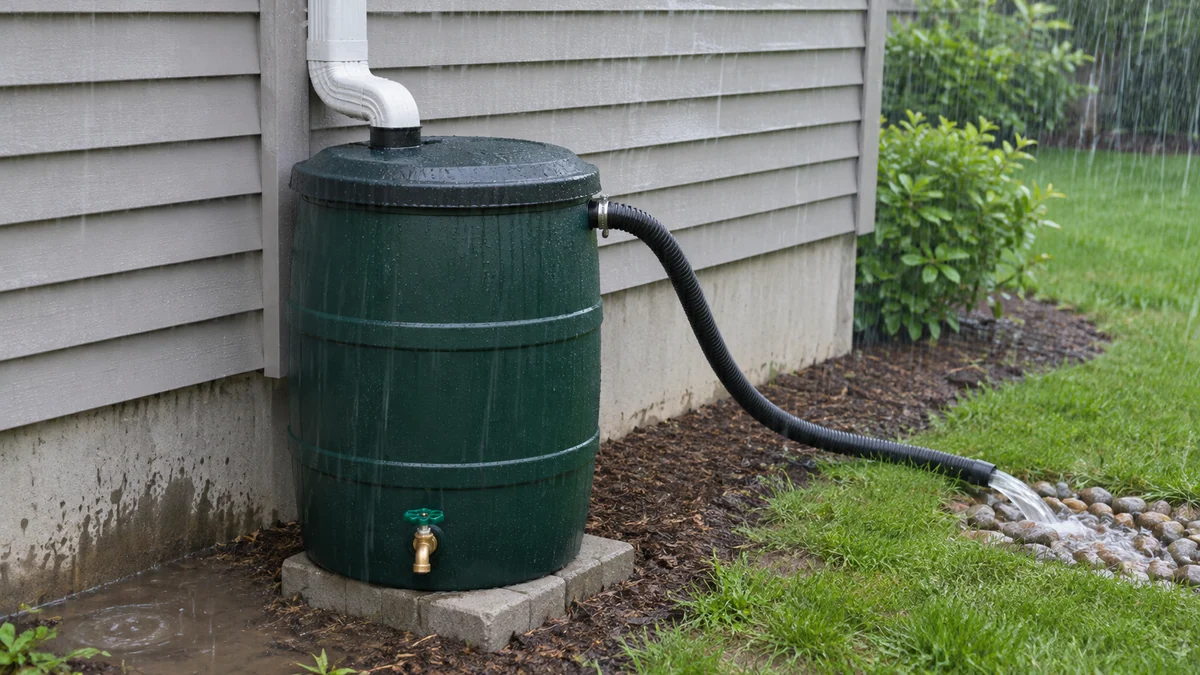
Design for a full barrel first
You can feed a rain barrel from an existing downspout if the connection is compatible and excess water still has a clear route away from the house. Decide where that water goes before choosing the barrel or cutting the downspout. The outlet needs to work even when the barrel starts the storm full. If water currently pools at the wall, fix the discharge route before adding storage.
I start with the storm that matters most to the house. A barrel can catch roof water for landscaping when it has room. Once it fills, new water has to bypass the container or leave through a designated overflow. In Dallas–Fort Worth, look at how the corner of the house behaves after a strong rain. If the only place water can go is a low bed beside the slab, a barrel at that spot can make an old problem easier to see without solving it.
Follow the route from the roof edge to the ground
Stand back and identify which section of roof feeds the downspout. A short run above a porch collects water from a different area than a long gutter fed by a roof valley. You do not need to climb up to make a useful sketch. Mark where the downspout reaches the ground, where the water goes now, and the direction it would travel from the barrel. Include walks, patios, doors, and the property line. These can change what is practical even when there is enough room for the barrel itself.
During a steady rain, observe from a safe, sheltered spot if you can. Check whether water reaches the current outlet and whether it flows away or backs up. A gutter spilling from the top or a seam spraying water below the roof may point to a separate issue. My guide to gutters overflowing at the foundation helps identify which part of the existing system to look at first. A new barrel will depend on that system being able to carry water to the connection.
A rainy-day photo also helps you identify roof flow that never gets into the gutter. If water jumps the gutter where two roof slopes meet, address that before sizing the barrel around the full roof area. If the run stays dry at the outlet while the gutter fills, ask a gutter professional to check for a blockage or a connection problem.
Choose between a bypass and a separate overflow route
Some diverter kits direct water from the downspout to the barrel until it reaches the intended level and then send subsequent flow down the original path. A setup that routes the downspout straight into the barrel needs a separate overflow that can carry water to a suitable location. In both cases, read the manufacturer's instructions and identify which route carries water during a storm with the barrel already full. Avoid assuming that the barrel's garden hose connection is the same as its designed overflow.
The City of Dallas drainage manual describes roof water collection and recommends routing overflows away from structures and downstream properties. When the original downspout discharges correctly, keeping that route available can make a compatible bypass practical. If the existing outlet runs under a walk or connects to a buried line, find out where that line discharges and whether it works. A buried connection with no known outlet deserves a closer look before it becomes your only path for excess water.
Check space for the connection and for routine use
Look for a stable, level location for the container. A full barrel is heavy and the support must be appropriate for the product and site. Give yourself room to reach the screened opening, outlet, and overflow after installation. It can be tempting to use the narrow space behind a shrub to hide the barrel. If you cannot reach the filter without moving the barrel, clearing debris will be harder when you need to do it.
Find out whether the downspout has space for the proposed fitting and whether it can be supported after the change. Take a photo showing the lower run, wall attachment, elbow, and outlet in one frame. Record the shape and dimensions of the downspout if you can reach it safely. Keep the gutter above in the picture too. If the configuration changes, those photos will show what the installer needs to preserve, including the original discharge path and access for maintenance.
Bring us photos if the downspout is hard to adapt
Before you purchase equipment, send a wide photo of the corner, the outlet, the place you want the barrel, and the proposed route for overflow. Tell us whether the outlet runs to daylight or disappears underground. Include the connection instructions for the barrel or diverter if you have them. We can discuss the gutter and downspout portion of the project and identify questions that need a drainage specialist or a rainwater system installer.
I would ask for an on-site look when you have recurring water at the foundation, a downspout hidden behind a tight corner, or a full-flow route that crosses a walking surface. If the roof already puts heavy flow into that run, check the size and placement of the gutter outlets before taking anything apart. Our guide to gutter and downspout sizing explains why the roof and the amount of water matter when you compare proposals.
Think through a storm and a maintenance visit
Ask what happens if the barrel is full, the screen collects leaves, or the connection needs to be disconnected. Some products have a way to return the system to normal drainage when the barrel is out of service. Ask the installer to show you that arrangement. Save the instructions and mark which opening is the overflow. If the barrel is temporary or has to come out for weather, keep a plan for putting the downspout back into a working configuration.
The EPA's rainwater harvesting guidance discusses screened openings, mosquito prevention, and stable bases. Treat the stored water as nonpotable unless a qualified professional has designed a system for another use. Check the barrel instructions for routine maintenance and where roof runoff can be used. Clean the screen and make sure the outlet route is still clear after yard work. An extension that was moved for mowing should go back where it directs water away from the house.
Write down who will do those checks if the house is rented or several people do yard work. Make the outlet part of the seasonal inspection, so a disconnected hose is easier to notice before the next downpour. Include the barrel lid in that check, since it should sit as the manufacturer intended.
Compare estimates by what each installer owns
Ask which parts are included in the price. Gutter and downspout work can include adapting the connection, replacing a damaged section, and securing the downspout. Someone else may be supplying the barrel, preparing its base, or connecting a longer drain. Write down where one person's responsibility ends and the next begins. If nobody owns the overflow route, you could pay for a usable barrel and still have water going to the wrong place.
Cost depends on the existing downspout material and condition, how much it needs to be moved, the fitting the barrel requires, and whether a safe discharge location is close enough to reach. Discuss whether an existing connection can stay intact and what it costs to restore the original outlet if the barrel comes out later. My questions to ask before hiring a gutter company can help you get that scope in writing.
See how the finished connection behaves
Before calling it done, ask the installer to show you which path water follows with room in the barrel and which path it follows when full. Have them show where the excess water comes out. This is an important step if the hose disappears into a bed or a downspout extension is partly hidden. If you cannot tell whether the output is pointed away from the building, ask where to stand to observe it safely after a rain.
Look at the ground where the overflow ends. A visible outlet makes inspection easier, but seeing it does not prove that water continues in the right direction. If it runs back along a patio or settles against another wall, take a photo from far enough away to show the slope. Ask who can evaluate the next step. A working connection should be part of a route that makes sense across the whole property.
Bring your planned location and your existing drainage problem
If you are considering a rain barrel for a Dallas-area house, tell us what you want to use the water for, where the container would sit, and what the downspout does now. Share any pooling you have observed, where the water travels after it lands, and whether other people use the area as a path. Send the product instructions too. We can look at how the connection would affect the gutters and what has to stay accessible.
When you compare locations, put the full-barrel route at the top of the list. The closest corner to the garden may look convenient and still be a poor choice if there is nowhere for extra water to go. A spot with good access to the screen and a working discharge route is easier to live with. If a proposed location depends on solving a bigger drainage issue, settle that scope before a downspout is cut.
Questions people ask me
Where should rain barrel overflow go?
Choose a route that carries excess water away from structures and avoids creating a problem on a neighboring property or walking surface. If the site has limited slope or a buried drain, ask an installer or drainage specialist to evaluate it.
Will the rain barrel make my gutter overflow?
A compatible setup should preserve a path for water when the barrel is full. A clogged inlet, blocked outlet, or poor connection can cause trouble, so ask how the full-barrel path is sized and maintained.
Can I use rain barrel water inside my house?
A simple roof-fed rain barrel is intended for nonpotable uses. Follow the product's guidance and talk with a qualified specialist if you are considering a different system.
Do I need to replace my gutters first?
Often the existing gutter can remain if it is sound and drains to the chosen downspout. A sagging gutter, damaged outlet, or recurring overflow should be assessed before you add the connection.
Sources
Keep reading
More from Jordan
- Getting a new roof? When to replace the gutters at the same time, and when to keep them
- Rotted wood behind the gutters: why fascia fails and when to replace it before new gutters
- Aluminum, steel, Galvalume or copper: choosing a gutter material for a Dallas home
- What new seamless gutters cost in Dallas, and what moves the number
Your home
- Roofing · Chris
- Painter · Andrey
- Power Washing · Doug
- Foundation & Concrete · TJ
- Drywall Repair · John
- Handyman · Lindsay

