
Print Advertising · 7 min read
When should you reserve magazine ads for a seasonal business?
The best issue for a seasonal service depends on when the customer decides, how the issue reaches them, and which appointments the business can still offer.

Work backward from when you want the customer to call
For a seasonal service, I would reserve a neighborhood magazine issue based on when customers begin comparing and booking, well before deciding by the month when crews are busiest. Start with the appointment dates you can offer and work back through the time customers need to choose. Ask the publisher when the issue is expected to reach homes and when your space and artwork need to be confirmed.
Consider a business that refreshes outdoor spaces before a holiday. If most of its work needs several visits, the right customer might have to inquire while other households are still thinking about their plans. An issue that arrives near the holiday can help with future interest, but it may be late for the appointments the owner intended to fill.
At The Good Life Park Cities, we publish a monthly neighborhood magazine. In a conversation about timing, I want to know what dates you could honor if a homeowner called today. That gives us an actual window to work from and an honest promise for the ad.
Find your customer's decision window in last season's records
Start with recent calls, estimates, reservations, or orders that led to a completed job. Record when each customer first contacted you and when you agreed on the work. A job on the calendar may have been arranged several conversations earlier. The inquiry date tells you more about when a print ad could have prompted action.
Look for different patterns within the same business. A homeowner who needs a service on a specific weekend may plan earlier than someone with a flexible date. A repeat customer may need only a reminder. A new customer may ask for photos, a site visit, and a written proposal. Set your target around the buyer and type of work you want the issue to bring in.
If you have little history, ask the staff who answer the phone what people usually say when they call. Are they comparing providers, trying to meet a date, or looking for general information? Make an assumption you can test and write down how you arrived at it.
Separate the mail window from the artwork deadline
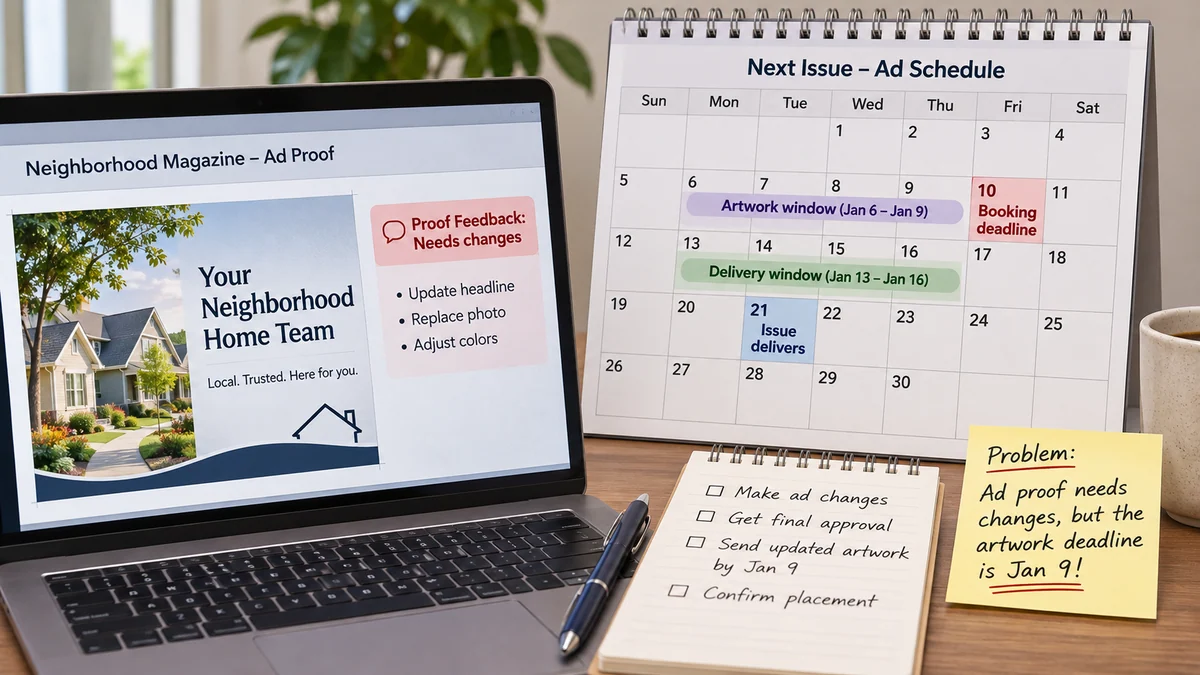
I would put the reservation deadline, proof deadline, expected delivery, and customer decision window on the same calendar. The name printed on the cover is only one part of that calendar. Confirm the expected mail window with the publisher, including how changes are handled and when you need to submit the materials.
The publication's advertising page explains that its print edition is mailed to targeted neighborhoods. If the geography matters for your crew, compare the households you want to reach with where the publication is distributed before reserving space. Readers can hold on to a copy and respond later, so choose language that will still be accurate after the first expected mail days.
If you have never bought space in a neighborhood publication, our guide to what happens after you book a magazine ad explains the work between reserving a spot and seeing the issue. Have the right person available for the final proof.
Give each issue an appropriate job
An earlier issue can help a reader recognize the problem and understand what to ask before getting an estimate. An issue closer to the active booking window can be more direct about the kind of appointments you are accepting. If you plan to use more than one issue, I would give each piece an honest reason to appear and keep the company name and contact method consistent.
Think about the message a reader can use. A florist who wants seasonal event work could help people understand which decisions need a venue or date first. A home-service business might explain what photos to take before asking for an estimate. Those ads give customers a useful starting point and prepare them for a better first conversation.
If you want to compare possible issues, tell me when the work starts, the type of customer you want, and how much lead time that customer normally needs. I can discuss the publication's timing and help you decide which message fits the space and date you are considering.
Protect capacity without making the ad vague
An ad with a firm promise about availability is hard to update once it is printed. Before approving language about timing, ask the person who runs your schedule what is safe to say. You can invite someone to check available appointments for a type of project without claiming that every date will still be open.
Give readers a route that stays useful through the campaign. If you send them to a page, make sure it explains the relevant service and how to ask about dates. A business that changes its booking availability frequently can keep the printed message simple and update the next step on that page. Someone on staff should know who owns the updates.
I would also think about the people who call after the priority period. If you can offer a waitlist, the next available period, or a different service, agree on the response before the phone starts ringing. If the business cannot help with an urgent request, give staff enough information to say so promptly.
Ask what the reservation commits you to
Find out when a reservation becomes binding and what happens if your proof is late or the service changes. If an offer, placement, or run of issues matters, ask for it in the written terms. Our guide to reviewing a magazine advertising contract explains questions to ask before you commit.
Budget for the work after reserving space. A dated offer may require fresh artwork, new photos, or a new web page. Reusing a prior ad can be a reasonable choice if the message is still accurate and the phone, link, and offer work. Make someone responsible for opening the link and reading the actual proof before it is sent.
Decide whether one issue provides enough room to test the approach or whether repeated appearances make sense for the service you are selling. Look at the difference in total cost and workload. I would keep the first campaign small enough that the team can see what happened and adjust without guessing.
Decide what counts as a useful response
Choose something the team can record at the point where a prospect gets in touch. An inquiry about a job you can perform is different from a click, a wrong number, or a service request from outside your area. Record the inquiry date, the service, and whether there was an estimate or booking. If you ask how the customer heard about you, capture their answer in their own words.
Our guide to measuring a print ad describes ways to keep those signals organized. Compare responses with the timing of the issue and the dates you had open. A campaign may have reached the intended reader and still brought too many requests for days you could not serve.
Review the campaign once you can see what happened to the inquiries. If good prospects called late, shift the issue earlier or change the action you ask them to take. If they called early and then went quiet, check whether the next step was clear and who followed up.
Leave time to prepare the artwork and response together
Gather a photo you have permission to use, your service language, contact information, and the page or number you want people to use. Decide what detail makes it easier for someone to take the next step. It may be the part of a property you work on, the type of event you handle, or the information you need before you can quote.
I prefer to review the ad and the next step as one experience. A homeowner should recognize the same business and service after they follow the printed instructions. At a Dallas business where several people answer inquiries, give staff the ad and the relevant dates so the reader does not have to explain what was printed.
What a weather-dependent schedule changes
If the work depends on weather, review the last season for jobs that moved and the reason each one moved. Your ads may bring inquiries at the right time and still leave the crew with overlapping work after a stretch of rain. Ask whoever reschedules jobs how much room they need and whether some work can be booked for a range of dates.
For a Park Cities service business, I would build the ad around the decision a homeowner can make now. Invite them to discuss the work and available windows. Give them a reasonable way to plan around uncertainty while the service team confirms what it can deliver.
What to bring when we talk about your season
Bring your busiest periods, the dates you can still book, and a rough picture of when prior customers first got in touch. If you are planning more than one service, decide which one matters most for this campaign. Mention any dates you want to avoid so we can account for those before discussing an issue.
I would compare your customer decision window with our publication calendar and talk through the next deadline you would actually need to meet. If the nearest issue comes too late for the work, we can discuss a later booking window or a message you can still deliver. An ad works better when the business can do what it asks the reader to do.
Questions people ask me
Should I buy the issue that arrives during my busiest month?
Start with when customers make decisions for that month. If they normally reserve earlier, a preceding issue may match the period when your team still has useful openings.
How far in advance does my artwork have to be ready?
Ask the publisher about the specific reservation, proof, and artwork deadlines. Leave room for your own review and for checking any phone number, link, or offer that will appear in print.
Can one print ad cover two seasonal services?
It can if the same customers need both and the next step stays clear. If the services have different booking windows, decide which one the issue is meant to support.
What if my schedule fills after the issue goes to print?
Keep the printed invitation accurate and update what customers see when they call or visit the linked page. Tell staff how to handle later inquiries, including when the next relevant appointment is available.
Sources
Keep reading
More from Doug
- Just opened near the Park Cities? How to get neighbors to know you are there
- Display ad or sponsored expert column: which one a neighborhood business should run
- Is your business a fit for a neighborhood magazine? Five tests to run before you buy an ad
- Your ad sends neighbors to Google first: keeping listings and reviews ready all year
Running a business
- Business Consultant · Armando
- Business Broker · Michael
- Franchise Consultant · Avinash
- Recruiting and Staffing Services · Chase
- Information Technology · Anthony
- Computer Software · Brandon


